
Updated September 2026
Is there life after teaching? Here’s what I learned after I left.
Established in 2019, Teacher Career Coach is a community sharing honest advice for teachers considering new careers. Featured in WSJ, NPR, and Yahoo News, 10k former teachers have used our resources to get new roles.

It’s weird to leave something you thought would be your forever career. Maybe it did make you happy for a while. Things change, and that’s okay.
Leaving the classroom was one of the hardest things I’ve ever done. But pushing through that struggle set me up to keep doing hard things, in my career and in my personal life. I had incredibly low self-esteem when I started, and my confidence kept growing. I went on to work for companies like Microsoft and GoGuardian, and eventually built my own company with six employees.
If you’re wondering what lies beyond the walls of the classroom, I know those can feel like lonely thoughts. “What about the kids?” Well, what about you?
My story: why I left teaching
When I started teaching fifth grade, I was excited to give back to my community. I enjoyed my students, but I had a feeling deep down that I was drowning. I convinced myself it was first-year jitters. Spoiler alert: it wasn’t. The first-year jitters became second-year jitters, and by year three I was constantly questioning whether I’d chosen the right path.
I moved to a new district for what I thought was my dream position. Instead of a fresh start, I landed in a toxic work environment. I was giving up every bit of my personal time, and it still never felt like enough. I was seeing my doctor more and more often for stress, and I still felt guilty for even thinking about leaving.
When I finally decided to leave at the end of that year, I panicked. I had no idea where to start. I spent days online piecing together advice, built an exit strategy, grew my network and applied to jobs that fit my skills. After hundreds of applications and many rejections, I got my yes: a job as an educational consultant. That role led to instructional design, freelancing, bigger companies and, eventually, this business.
4.25 / 5
average happiness former teachers report in their new roles
2.63 / 5
how happy the same people say they were in the classroom
94%
say their work-life balance is better or much better
Source: Teacher Career Coach 2025 Job Market Survey of former teachers. Hear the full breakdown in episode 199.
10 things I learned after leaving the classroom
1. Life is short. Your job shouldn’t make you miserable.
This is the most important lesson I learned. My physical and mental well-being were at stake, and my relationships were suffering. By my final year, it had become routine for me to cry on the way to school and reapply my makeup in the parking lot. I knew I couldn’t stay five more years, let alone 20.
If your work affects every part of your life negatively, it’s time to re-evaluate. Your health is more valuable than sticking it out in any career.
2. You’re not getting paid as much as you think.
When you’re on salary and working long hours, it doesn’t add up. I did the math on my hourly pay and was dumbfounded. I made more in my first year as an educational consultant than I ever did in the classroom.
The hourly math that changed my mind
Same $55,000 salary, two very different years
Teaching
~$23/hr
39 weeks × 60 hours = 2,340 hours a year
A 40-hour-a-week job
~$26/hr
52 weeks × 40 hours = 2,080 hours a year, plus 260 hours of your life back
What struck me most was what I could do with those 260 hours: read a book, meet a friend for a drink, build a side project. (Curious how your pay compares? See will I make more than my teacher salary?)
3. It’s easier to build extra income when you have work-life balance.
My consulting job gave me so much free time that within a few months I started a Teachers Pay Teachers store, and later this website and the Teacher Career Coach Course. I never would have had the time or energy for those projects if I’d stayed in the classroom.
One honest update: I don’t recommend TPT as enthusiastically as I used to, since AI-generated resources have flooded the market. But the lesson still stands. Having your evenings back opens doors. Here are some part-time jobs and side hustles for teachers to explore.
4. You can still support education after you leave.
I quickly learned that leaving the classroom doesn’t mean you can’t make a positive impact on education. I volunteered at a creative writing workshop for students, and as a consultant I helped districts find grants and resources for their teachers. You can work for an education company, create resources, work with kids in another setting or volunteer. Teaching is not your only option.
5. Other teachers will start asking you how you did it.
I felt so alone during my transition. Yet within weeks of announcing my new job, I had texts from former coworkers asking for advice. Teachers came up to me after presentations. A principal even asked if my company was hiring! That’s what inspired me to create Teacher Career Coach in the first place. If you feel trapped, you’re not alone.
6. You don’t have to give up flexibility.
I was scared to lose summers and holidays off. What I found instead was flexible paid time off with no sub plans, and weeks that ended when the work was done. Not every company works this way, so check job descriptions and careers pages. Here’s how I think about jobs with summers off.
7. There’s more upward mobility in other careers.
As a teacher, I could see my entire pay scale laid out in front of me. The only way up seemed to be administration, and I had no desire for that. Outside the classroom, I could see the roles above me, make a plan and often learn the skills on the job. I’ve watched another former teacher quadruple her salary within a few years of leaving.
Pay after leaving the classroom
What former teachers reported in our 2025 Job Market Survey
717 former teachers. Only 9% started at $90k or more.
I won’t pretend it’s easy. Almost half took a pay cut to get out, and many of the raises came after a year or two in the new role. But the growth is real.
8. Networking is how most people get hired.
Finding a teaching job felt easy. Outside education, I was totally lost, because my network was all teachers. Once I started meeting people in other roles, I was offered jobs on a consistent basis. I was approached about my first instructional design role even though I was underqualified, because people in my network could vouch for my work ethic.
In 2026, this matters more than ever. Among recent career changers in our survey, networking and referrals were the top thing that got them hired (25%), now ahead of resume tailoring.
9. Salaries can be negotiated.
This one blew my mind. Teachers rarely negotiate, but in most other industries starting salaries are negotiable. Research the typical range for the role in your area, and remember that every company’s budget is different. After learning how, I negotiated my starting salary to 16% above the original offer. (Here’s more on salary negotiation for teachers.)
10. You are not failing. You are growing.
I felt like an absolute failure in my last year of teaching. There’s a stigma around teachers who leave: we’re selfish, weak or selling out. The truth is, my life after teaching vastly improved. It felt like a cloud lifted.
I also recognize the value of my time in the classroom. I would never be where I am today without it. The companies I’ve worked for valued the skills I built as a teacher. It wasn’t a failed attempt. It was a stepping stone.

“It wasn’t a failed attempt. It was a stepping stone.”
What life after teaching looks like in 2026
I’ll always be honest with you about this: it takes longer to land a role than it did a few years ago. Former teachers in our survey reported needing 40 to 50 applications, up from about 30 in 2022 and 2023. More recent career changers are starting in entry-level roles or taking a pay cut to get their foot in the door.
If you’re planning your exit
- Get clear on your numbers first: your budget, your cost of living and realistic starting salaries for the roles you want.
- Try to line up your next job before you resign. I’m a planner, and in this market I wouldn’t leave without one.
- Start networking now, while you’re still teaching.
- Learn how to translate your teaching skills into the language of the job you want.
If guilt is what’s holding you back, I wrote about teacher guilt too. And if you’re still deciding, start with why teachers quit and how to know if it’s time or should I leave teaching?.

Frequently asked questions about life after teaching
Is there life after teaching?
Yes. Former teachers work in instructional design, project management, customer success, sales, HR, nonprofits, higher education and education companies. In our survey, 94% said their work-life balance is better or much better than it was in teaching.
What do teachers do after they leave teaching?
The most common paths are learning and development (including instructional design and corporate training), project management, customer success, sales and account management, operations and nonprofit roles. See the best jobs for former teachers for the full list.
Do teachers regret leaving teaching?
Some miss their students or their summers, but most former teachers we hear from are happier. Survey respondents rated their happiness 4.25 out of 5 in their new roles, compared with 2.63 as teachers.
How long does it take to find a job after teaching?
In 2026 it often takes months, and some former teachers say six months to a year. Recent career changers reported sending 40 to 50 applications, and some sent more than 100. Networking and a well-translated resume shorten the search.
Is it normal to feel guilty about leaving teaching?
Very. Many teachers feel like they’re abandoning their students or failing. Leaving a job that’s hurting your health isn’t selfish, and the skills you built as a teacher go with you.
Will I make more money after leaving teaching?
It depends on the role and where you live. In our survey, about half took a pay increase in their first role, and 64% have received a raise since leaving. Many recent career changers started below their teaching salary, so plan your finances before you resign.
You know yourself and your situation better than anyone else. I invite you to help me rewrite the script. There is life after teaching, and for many of us, it’s a better one.
Start building your life after teaching
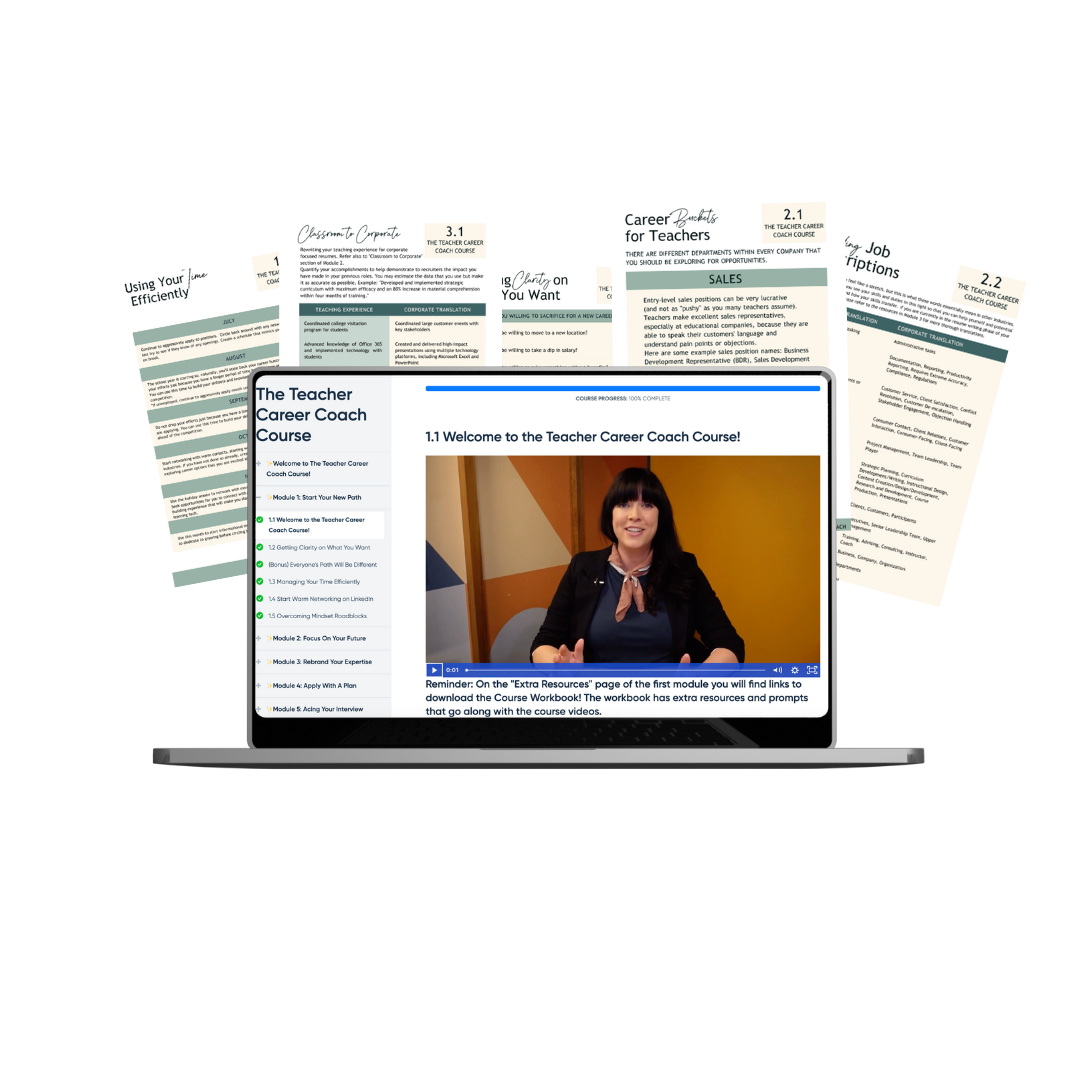
The Teacher Career Coach Course walks you step by step through choosing a new path, translating your resume, networking and answering tricky interview questions.